
Crete in the time of Easter

I have flown to Crete for a week and am doing a tour by bus. The first few nights we are staying in Rethymnon on the north coast of Crete. It is a small town with an old town full of character. I was here in 1990, but I don't remember much, but what I think I remember, has nothing to do with how it looks today. Probably because tourism has developed quite a bit, and some of the places in town are very touristy. It is early in the season so it is not too crowded.
The Imbros Gorge
The largest and perhaps most popular gorge on the island is Samaria. It is still not open because at this time of year there is still water at the bottom, which makes it dangerous to walk there. We walked in the Imbros Gorge instead. Not that I minded, as it is only 8 km, compared to Samaria which is 16 km.
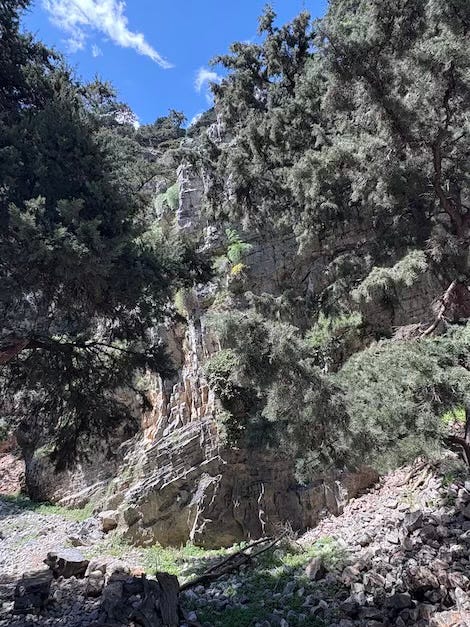
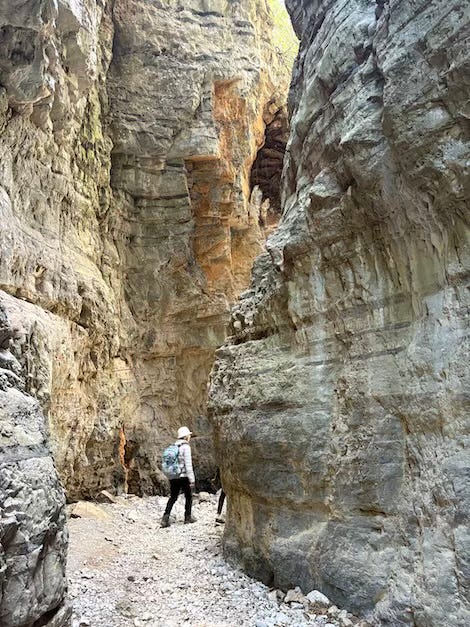
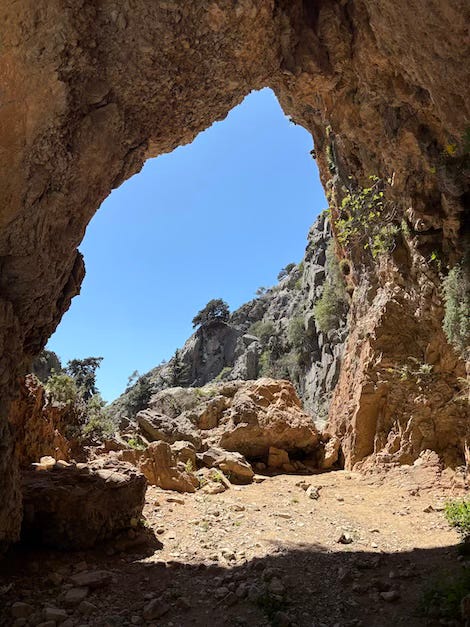
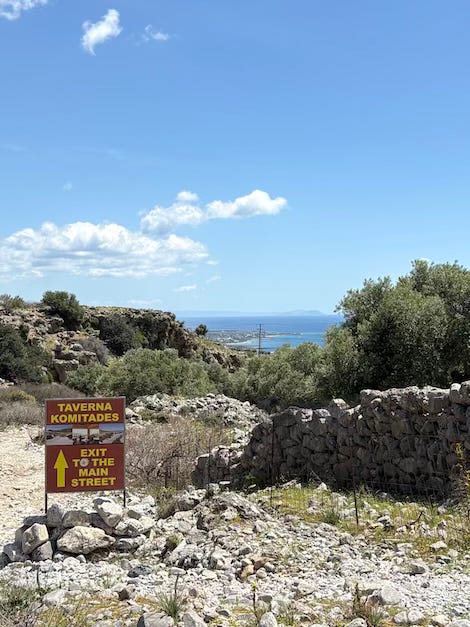
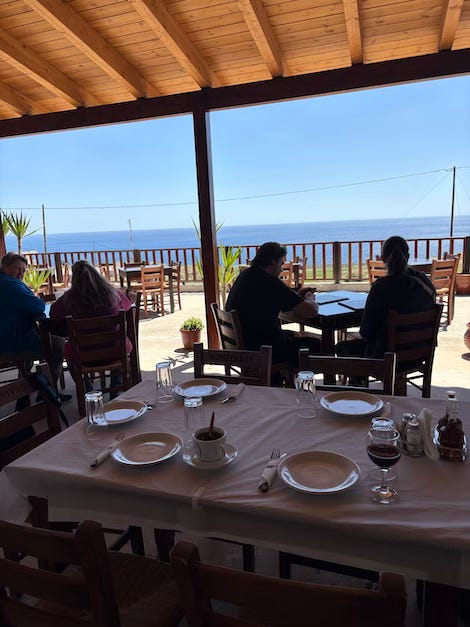
It was quite windy through the gorge that stretches from north to south. I would have needed a hat. Who would have believed it? The walk through the gorge was beautiful, but quite difficult. The ground is uneven, full of rocks of different sizes that move under your feet. Even a little climbing in some places. From wide to narrow paths where the cliff sides only leave about 1.5 meters to pass. It took us almost four hours to walk down to the sea, where a lunch awaited, with a lovely view of the sea. Well deserved I would say. Maybe I don't need to tell you what terrible muscle pain I have today?
There are about 400 gorges on the island. Do you want to know how they were created? I guess so. It all depends on what you believe. Do you want to believe the more scientific story of how rain, wind, rocks and water carved the earth over millions of years? I don't think so. You probably want to hear the real story. Which means we have to go back to Hesiod, a Greek poet who lived around 700 BC, who retold the story in his Theogony.
In the beginning there was chaos. Out of it came first Gaia, the earth, and she created Uranus, the sky, who fit perfectly around her, and she made him her equal. Gaia and Uranus had twelve children, the Titans. Then she gave birth to three Cyclopes and the three Hecatoncheires. Uranus, who hated these last children, pushed them back into Gaia, who suffered terribly from the pressure.
Gaia was not happy with Uranus and decided to take matters into her own hands. She created a sickle and asked her sons to use it against their father. Only Cronus accepted the challenge. When Uranus came to lie with Gaia, he cut off his father's genitals and threw them into the sea. From the sea foam that emerged, Aphrodite, the goddess of love and the only Olympian god not descended from a titan, was born.
The Titans married and had many children and grandchildren. Cronus became ruler and married his sister Rhea. A prophecy said that Cronus, like his father, would be deposed by one of his own children. Cronus's remedy for the prophecy was to swallow his children. The children were Poseidon, Hades, Hestia, Demeter, and Hera.
Rhea was very sad about not being able to see and touch her children, so when she became pregnant again, she traveled to Crete where her son Zeus was born. She kept him hidden and instead sent Cronus a stone which she enclosed in a cloth. He thought it was the child and swallowed the stone. When Zeus grew up, he and Gaia conspired to make Cronus vomit up Zeus's five older siblings with a special potion.
After being overthrown by his son Zeus and imprisoned in Tartarus, Cronus was in a rage. One night, as the stars shifted over Crete, Cronus darted across the borders of the underworld and emerged on the island where Zeus had once been hidden as an infant. Furious at the betrayal of his own blood, Cronus sought to destroy the island that protected the god who had deposed him.
“The earth trembled. Mountains cracked. And from the depths of Olympus, a challenger emerged—not Zeus, but a younger god, a protector of nature and stone. Some say it was Hephaestus, risen in fury, or perhaps a forgotten Cretan deity, born of the land itself.
Their battle raged across the island. With every swing of Kronos’s scythe, the land split open, carving deep gashes that would become the Samaria Gorge, the Imbros Gorge, and all the other gorges that still today exist on the island. The younger god struck with hammer and flame, melting stone and shaping the cliffs in defiance.
The skies wept fire, the seas pulled back in terror, and for seven days and nights, Crete bore the scars of their clash. At last, the younger god summoned a final blow—binding Kronos not in chains, but within time itself, casting him into the deep recesses of the gorges he created, where echoes of his fury still whistle through the wind.
To this day, when storms rise suddenly over Crete and winds howl through its gorges, the locals say, "Kronos stirs again."“
And Zeus? He and his siblings lead a struggle again the Titans, lasting for ten years, until they were defeated. Zeus and his family went on to be the Olympian gods who rule the world from Mount Olympos.
Well, I think Kronos might have stirred again the day we walked through the gorge, with the wind which seemed to come from all sides.
How interesting. I was in Crete years ago with my son's 8th grade. We also walked a gorge. I have no idea which one it was, just that it was quite a challenge for me and I wouldn't want to repeat now, so many years later. I only made it just back then.
But I loved to hear about the Greek gods. They are always a mystery to me, I just can't remember who is who. But nobody ever explained it like you. So, thank you.