
Japan - Hiroshima

I think most people know about Hiroshima and the tragedy. On August 6, 1945, Hiroshima became the first city in history to be attacked with an atomic bomb. Dropped by the United States during the final stages of World War II, the bomb—nicknamed Little Boy—detonated approximately 600 meters above the city center. The explosion instantly destroyed much of Hiroshima and caused devastating loss of life.
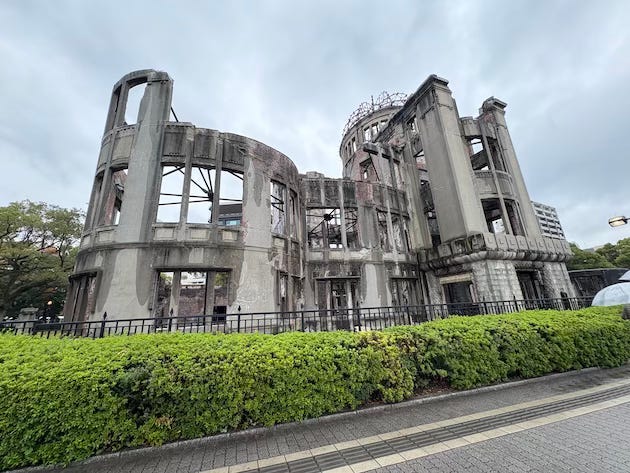
We visited the Hiroshima Peace Memorial Park which stood at the epicenter of the blast. The Park has been created to honor the victims and acts as an advocate for the abolition of nuclear weapons. The park includes memorials, museums, and the iconic Atomic Bomb Dome, preserved as a UNESCO World Heritage Site. After the war it was discussed whether the Dome should be torn down or be kept as a memory. The latter suggestion won and it now dominates the park which is beautifully set by the river. It is difficult to think that such a beautiful place has seen such tragedy.
There is no exact number of how many people died in the blast and firestorm. It is estimated that 70,000-80,000 people died immediately. By the end of 1945 around 140,000+ people had died, due to causes such as radiation sickness, injuries and longer-term effects. It is more difficult to determine long-term casualties that appeared over decades.
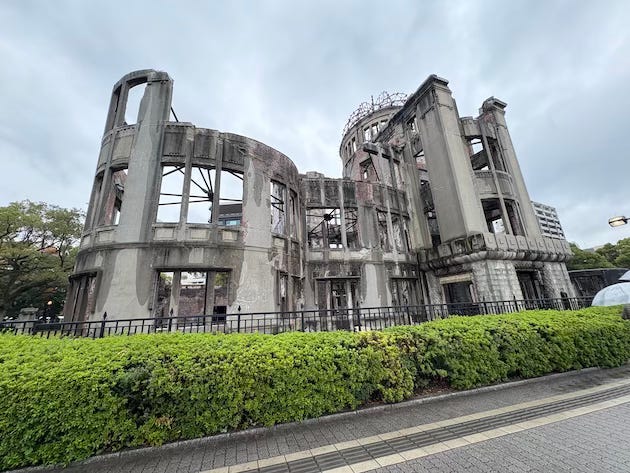
The question that many of us had was about the contamination and the effect it had on the people. Since the bomb exploded in the air, and not on the ground, it did not create lasting, radioactive contamination like that seen at ground-level nuclear test sites or reactor accidents. Today, Hiroshima is safe, fully rebuilt and has normal background radiation levels comparable to other major cities.
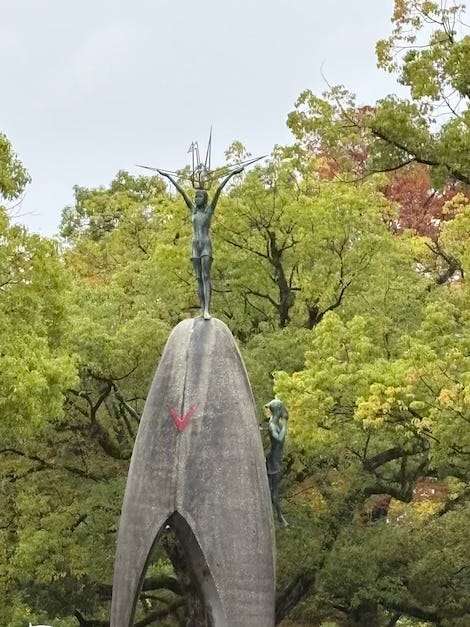
“This is the Children’s Peace Monument in memory of the children who died as a result of the bombing. On top of the statue is a girl with outstretched arms with a folded paper crane rising above her. The statue is based on the true story of Sadako Sasaki, a young girl who died from radiation. She is known for folding over 1,000 paper cranes in response to a Japanese legend. To this day, people, mostly children, from around the world fold cranes and send them to Hiroshima where they are placed near the statue.” (Wikipedia) The guide told us that all paper cranes are saved and today there are several hundred of thousands of cranes, which have now been given a new home archive in a nearby building.
The Island of Miyajima
In the afternoon we jumped on a local train that took us to the coast, and the ferry to the island of Miyajima (meaning Island of Worship). Here we find another UNESCO site, a temple belonging to the Shinto belief. Historically, people were not allowed to give birth or die on the island in order for it to remain ritually pure.
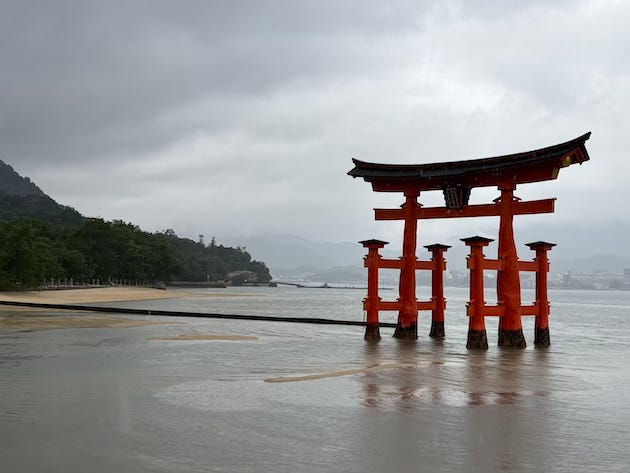
Itsukushima Shinto Shrine
The shrine dates back to the 6th century, though it took its iconic form in the 12th century, when the powerful warlord Taira no Kiyomori rebuilt and expanded it. He designed the whole complex to appear as if it floats on the sea, highlighting the harmony between architecture and nature, which is an important Shinto principle. The temple area is very big and you walk around on wooden walkways. The temple is dedicated to the three daughters of the storm god Susanoo, which are deities associated with the sea, navigation and fortune.
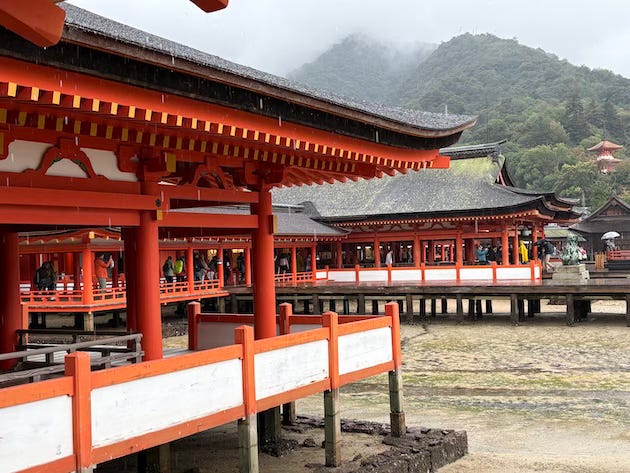
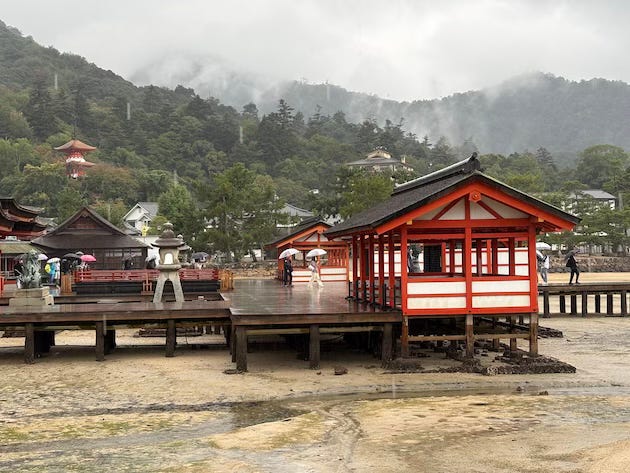
The Floating Torii Gate
The “floating” gate was constructed in the late 12th century and rebuilt several times. The current structure dates from 1875. It is built offshore, so the gate appears to float during high tide, symbolising the threshold between the human world and the sacred realm of the kami.
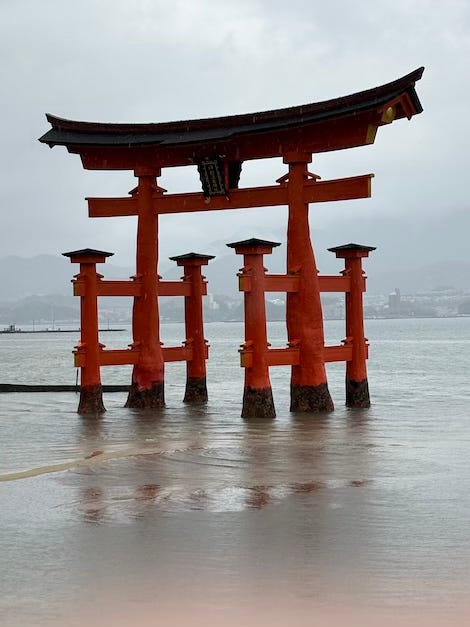
This gate is the most photographed place, or building, in Japan.
In the area from the ferry to the temple goats were running around wildly, protected by the religion.
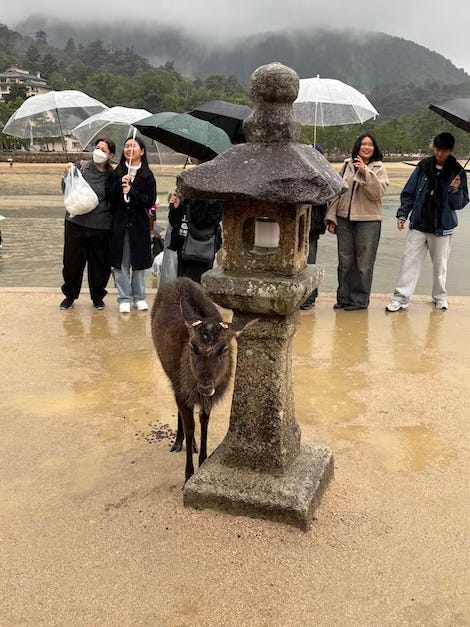
They were rather tame and people were feeding them. But from time to time they became somewhat irritated and started hunting the tourists. I kept the distance.
Interested in reading and books? Have a look at my book blog My Bookish Corner. Also here on Substack.
Oh, what a grand walk through memory lane. We have also visited Hiroshima and Miyajima and they were my two favorite stops during our Japan visit. The peace park and memorial museum are just fascinating and terribly sad in so many ways. I think everyone should visit and see it. I loved Miyajima and have memories of feeding one of the deer -- and also see one chase a many carrying a bag of what I'm guessing was his lunch down the street. The Torii is just amazing-- and yes, I photographed it too! Thanks for this!
Every war is a tragedy but this attack was especially so. I have read a few books on Hiroshima, every one of them sadder than the ones before. Thanks for taking us to the memorial. We can't mention this often enough.