
Knossos - and the myth

While I am busy in Paris, and will tell you more of my days here, I will re-visit Knossos with you. I visited it in 1989-90, but it has been more extensive excavations since then, so I was happy to visit again. We had a very good local guide who took us around the ruins of this palace from the Minoan culture. Before we go into the ruins I would like to go back to the myth. I am sure you have all heard about the monster in the labyrinth, but maybe you are not aware of the whole story.
The Minotaur, Ariadne, the thread and Theseus
The myth of Theseus and the Minotaur is one of the most famous stories from Greek mythology. Here's a summary:
King Minos of Crete had a monstrous creature called the Minotaur, half-man and half-bull, which lived in a vast Labyrinth designed by the inventor Daedalus. Every nine years, as punishment for the death of Minos' son, the city of Athens was forced to send seven young men and seven young women to Crete as a sacrifice to the Minotaur.
Theseus, the prince of Athens, volunteered to be one of the youths sent, intending to kill the beast and end the tributes. When he arrived in Crete, Ariadne, King Minos' daughter, fell in love with him and gave him a ball of thread to help him find his way out of the Labyrinth after slaying the Minotaur.
Theseus entered the maze, used the thread to mark his path, found the Minotaur, and killed it. Then he led the other Athenians out safely by following the thread back to the entrance. On the journey home, he forgot to change the ship's black sails to white—an agreed-upon signal to his father, King Aegeus, that he was alive. Seeing the black sails, Aegeus assumed Theseus had died and leapt into the sea in despair, which is said to be how the Aegean Sea got its name.
Minotaur - background
Europa was a Phoenician princess from Tyre. The European continent is named after her. The story goes that the young maiden was gathering flowers, saw the bull, and was fascinated by its handsome flanks and gentle behaviour (turned out to be a mistake) - caressed him and got onto his back. The bull was Zeus, and he took the opportunity to abduct her and swim to Crete. Here he revealed his true identity, raped and impregnated her. The result became King Minos of Crete
Minos was eager to assert his right to the throne of Crete, and prayed to Poseidon, the sea god. Poseidon sent him a snow-white bull as a sign of his support, with the understanding that the bull would be sacrificed in his honour. The bull was so beautiful that Minos did not keep his promise.
The gods are easy to anger and don’t like to be deceived. Poseidon thus enlisted Aphrodite, the goddess of love, to initiate the punishment. She cast a spell on Pasiphae, the wife of Minos, who fell in love with the bull. This union led to the birth of Minotaur, a creature with the body of a man and the head of a bull. As he grew and became more wildly a maze was designed and built by Daedalus. Daedalus is the father of Icarus and it was Daedalus who built the wings with which Icarus flew too close to the sun.
If you are interested to read a historical fiction on this story, I can recommend Ariadne by Jennifer Saint.
Knossos and its history
Knossos is the most famous centre of the Minoan civilization. It is dominated by the Palace of Minos, and its complex of buildings served as a combination of religious and administrative centres as well as a royal residence. The earliest parts are from 1900 BC, and it expanded over the centuries until its final destruction around 1350 BC.
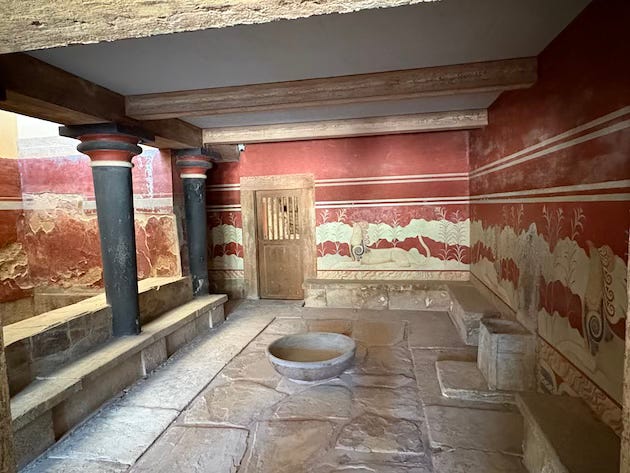
First excavated by Minos Kalokairinos in 1877. Sir Arthur Evans undertook more extensive excavations in 1900. He unearthed most of the palace as well as other now famous artefacts. His work is controversial, in particular for the reconstruction of the site. In those days when archeology was not very well developed, things were done which would never happen today. Evans used concrete to reconstruct parts of the temples which is not good for the original material. The guide said though, that Evans is still honoured today for the work he did. The value of the information he unearthed about the Minoan civilisation is undisputed.
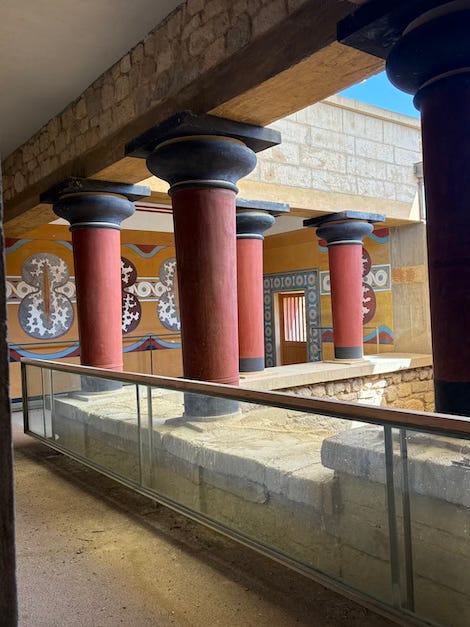
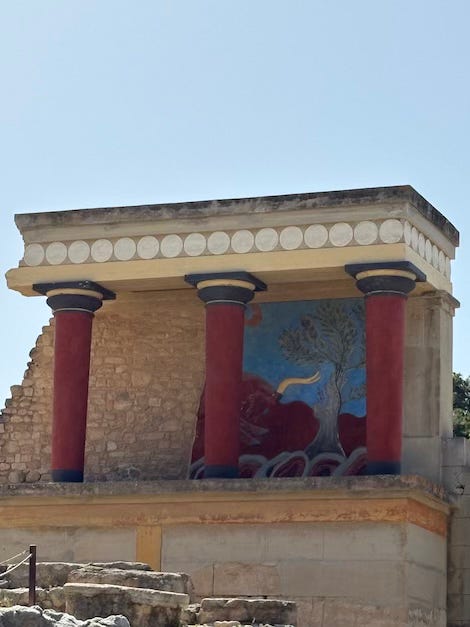
Among other things he uncovered thousands of clay tablets inscribed with what is called Linear B script. This script is very different from the Linear A which was also found on the site. The scripts are a mystery. The Linear B tablets date back to 1450-1200 BC. Since they were found in the administrative centres it is suggested that they were used for such records. It was only in 1952 that linguist Michael Ventris successfully deciphered the Linear B. It revealed that it was an early form of Greek. It would indicate that Greek speakers were present in Crete during the Minoan period. The Linear A has so far eluded any attempt to decipher it.
So what about the Labyrinth? Did they find it? Not exactly, and there are still different interpretations. Evans himself suggested that the complexity of the architecture of the palace had been the Labyrinth of Daedalus. Evans found various bull motifs, including an image of a man leaping over the horns of a bull on the palace walls. Other archeologists have explored other potential sites as the labyrinth, however, there is no certain place for it.
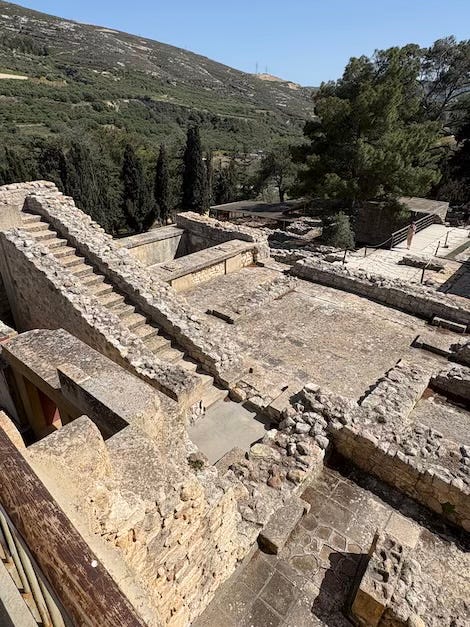
Walking around the ruins of the palace, one can very well imagine that the palace itself was the labyrinth. It is huge, and has so many different areas, going up and down, in and out of doorways, and when there were walls and a roof over the buildings, it could very well have felt like a labyrinth. I am sure there will be more interpretations and searches to find the true labyrinth. In the meantime, we can enjoy a walk around the area, and listen to the myth that established Minos palace and its inhabitants.
What I found in Paris
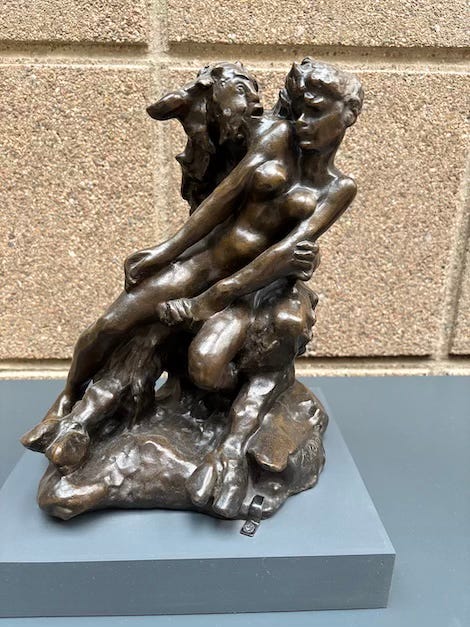
As I am going around Paris, visiting museums, I ran into a couple of images of the Minotaur. Auguste Rhodin has done a few sculptures of the Minotaur which are exhibited in both his own museum and at the Musée d’Orsay.
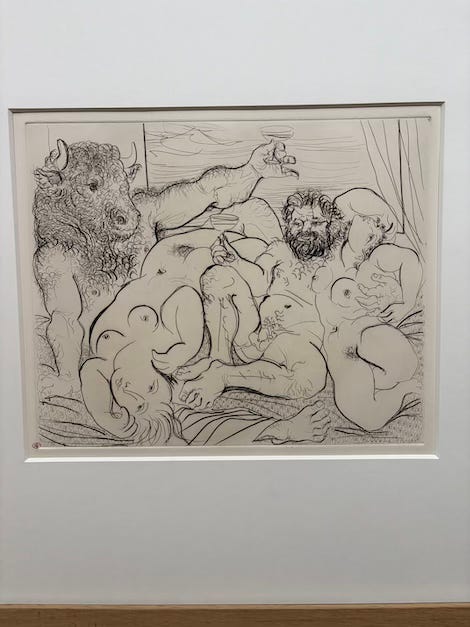
I also found a drawing by Pablo Picasso which is exhibited in his museum. As always he has his own interpretation of things.
I remember Knossos. It was beautiful.